Unit 1: Introduction to Data Validation

In this unit, we’ll discuss the importance of data validation in the overall process of data exchange, and we'll examine specific use cases for using FMR to validate data. Finally, we'll examine the features of the SDMX standard, which address data validation use cases.
What is data validation?
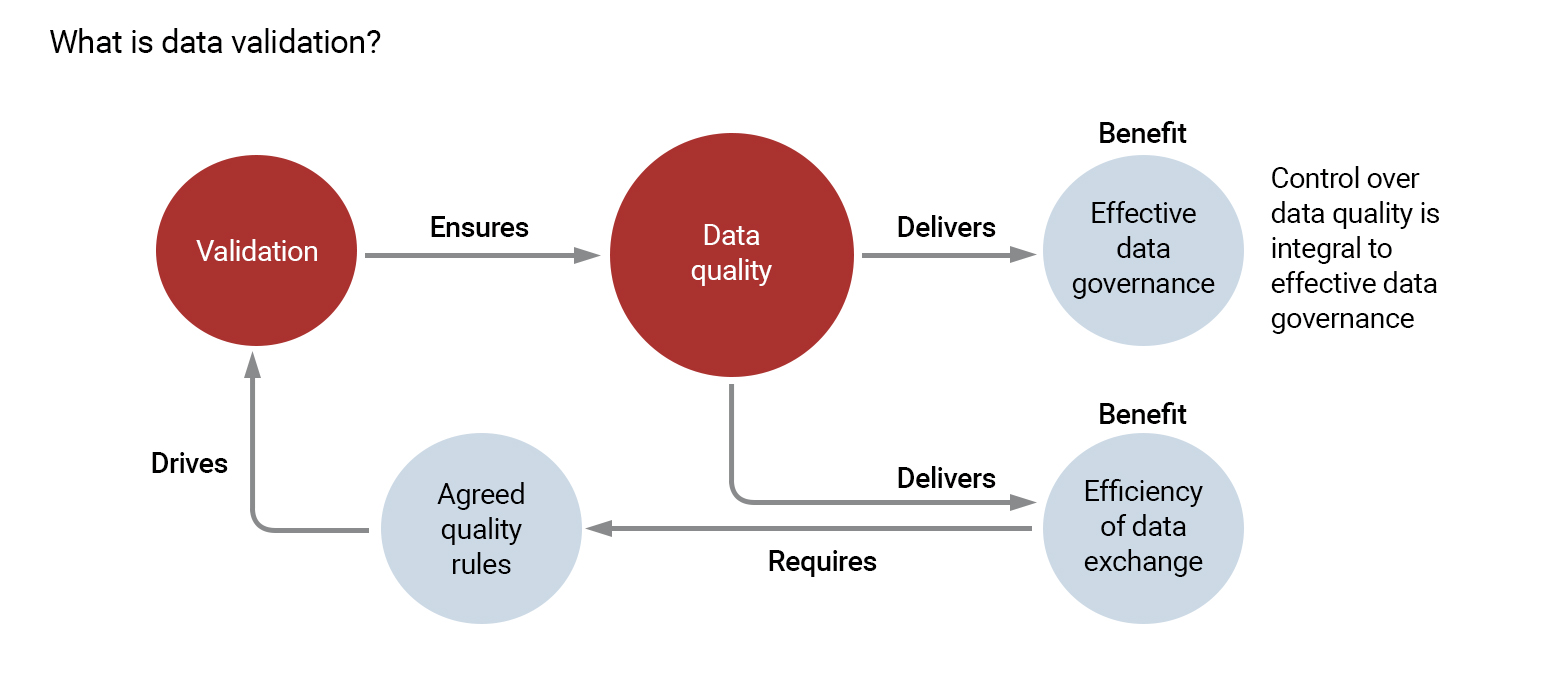 Data validation plays an important role in ensuring a high standard of data quality. This greater control over data impacts the overall effectiveness of data governance and efficiency of data exchange, as this flow chart illustrates. This process flows more smoothly if all parties agree on the rules that define good quality, which are then used to ensure data standards are met.
FMR data validation use cases
Shown here are the use cases for using FMR to validate data.
Select each use case example to learn more.

Data producers use FMR to validate reporting data using the collectors' rules prior to transmission.

Data collectors validate data received from data reporters.

Statisticians and economists set and enforce dataset quality rules.
Why an SDMX API?
What are some of the features of the SDMX standard that address the data validation use cases we just discussed? Below are a few key points describing the vision of SDMX.
Select each benefit for details.
SDMX aims to improve the quality of the statistical data and metadata that are exchanged. One of the main visions of SDMX is to standardise the exchange of statistical data and metadata. This involves creating universal formats and models for data and metadata that all participants can understand and use. By providing these standards and guidelines, it can help ensure that the data and metadata are accurate, complete, and reliable.
Another key vision of SDMX is to foster collaboration among international organisations and their member countries. By facilitating the exchange of data and metadata, it can help these entities work together more effectively and achieve their goals.
SDMX aims to facilitate and enhance the sharing and exchange of statistical data and metadata. By creating a common language for these exchanges, it helps to eliminate barriers and make it easier for all parties to share and use statistical data.
Another goal of SDMX is to enable automated (machine to machine) data sharing and process automation.
Finally, through standardisation, SDMX seeks to make the exchange of statistical data and metadata more efficient. This can help reduce the time, effort, and resources needed to share and use this data.

SDMX envisions driving innovation in statistical data and metadata exchange through its standards. It promotes the use of modern techniques, technologies, and best practices to keep up with the evolving needs of data exchange.
SDMX endeavours to facilitate data use through web services and connectors (Python, R, MS Power BI, and the like).

Ultimately, the goal of SDMX is to support decision-making by providing timely, accurate, and high-quality data. By improving the exchange and use of statistical data and metadata, it can help policymakers, researchers, and others make informed decisions.
What do you know?
Now that you've completed our introduction, try this.
How does SDMX drive innovation?
Select all that apply and then select Submit.
SDMX drives innovation through its standards. It promotes the use of modern techniques, technologies, and best practices to keep up with the evolving needs of data exchange. The API enables automation. As an international standard supported by open-source tools and modelling practices, there is a strong foundation to support collaboration and cooperation.
The correct answer is all of the above.
SDMX drives innovation through its standards. It promotes the use of modern techniques, technologies, and best practices to keep up with the evolving needs of data exchange. The API enables automation. As an international standard supported by open-source tools and modelling practices, there is a strong foundation to support collaboration and cooperation.
The correct answer is all of the above.
SDMX drives innovation through its standards. It promotes the use of modern techniques, technologies, and best practices to keep up with the evolving needs of data exchange. The API enables automation. As an international standard supported by open-source tools and modelling practices, there is a strong foundation to support collaboration and cooperation.
Coming next
In the next unit, you'll learn about the nine validation rules available in FMR and how to use DSD component representations and data constraints to define the universe of valid data. We'll also touch on checking balance equalities using validation schemes.
Need help finding something? I am an AI Assistant that's here to help!
Welcome to SDMX AI assistant
What are you looking for?
By using this AI-powered service ("Service"), you acknowledge and agree to the following:
This Service uses generative AI to assist with statistical analysis and research. While the Service strives to deliver useful information, the output ("Output") may contain inaccuracies, omissions, or biases. The Output is provided for informational purposes only and should not be considered professional advice. You remain responsible for how you interpret and use the Output.
The BIS makes no warranties regarding the accuracy or completeness of the Output and accepts no liability for any loss or damage resulting from its use.
Do not include or share personal, private, confidential or proprietary information when using the Service.
By using this technology, you agree to the Terms and Conditions.
How the assistant can help you
Understand SDMX standards
Ask and get clear explanations about SDMX standards.
Navigate the website
Find tools and documentation on website quickly.
Explore SDMX tools
Ask about API, software and libraries supporting SDMX.
Access documentation
Locate technical guides, specifications, and FAQs.